


What Happens If You Fail the CDL Air Brake Test in Washington?
October 29, 2026
Failing any part of the air brake check during your CDL skills exam means your test ends right away. You can’t move on to the backing or road test until you retest and pass.
If you take your CDL skills test in a vehicle without full air brakes, Washington State will issue your license with an air brake restriction.
An "L" restriction means you can’t drive any commercial motor vehicle with air brakes. This happens if you fail the written air brake test or take your driving exam in a truck with hydraulic brakes.
A "Z" restriction means you cannot drive a truck with full air brakes. This happens if you take your skills test in a vehicle with an air-over-hydraulic system.
Having either restriction on your Class A CDL can prevent you from driving full-air-brake trucks like:
- Standard heavy haulers
- Regional reefer fleets
- Port drayage trucks
What Happens After You Fail the CDL Air Brake Test in Washington?
Failing the air brake inspection means you cannot continue into the backing or road test that day. You’ll need to schedule another attempt.
Washington State generally requires a 3-day waiting period after your first failed CDL skills test. You may also need to pay additional testing fees.
However, if the truck itself has an equipment failure, the rules are different. Washington DOL does not require a waiting period or an additional fee for your next attempt.
Failing the in-cab air brake check also doesn't automatically place an L restriction on your CDL.
How Many PSI Can You Lose in an Air Brake Test?
During the 1-minute applied pressure test, the air loss limits depend on the type of truck you drive:
- Single Vehicle (Class B): Maximum 3 PSI loss in 1 minute.
- Combination Vehicle (Class A): Maximum 4 PSI loss in 1 minute.
If your primary or secondary air gauge drops faster than these limits, the truck fails the air leakage check. A mechanical problem needs repair, and Washington DOL handles equipment failures differently from a student failing the test procedure.
What Do Washington State CDL Air Brake Restrictions Mean?
In Washington State, commercial drivers must prove they are prepared to inspect and operate air brakes perfectly and safely. Since almost all heavy tractor-trailers on the road rely on compressed air to stop, driving a refrigerated trailer, hauling port containers, or delivering regional freight often requires a Class A license without an air brake restriction.
The Difference Between L and Z Restrictions
An "L" restriction blocks you from driving any truck equipped with air brakes. A "Z" restriction blocks you from driving trucks with standard full-air braking systems. Some motor carriers and logistics companies won’t hire a driver with an "L" or "Z" restriction.
The In-Cab Air Brake Test: Step-by-step
You must perform the in-cab air brake test in exact order. You must tell the examiner clearly what you’re checking, what pressure range you expect, and what your gauges show.
Step 1: Building Pressure and Governor Cut-Out
- Chock the wheels, start the engine and run it until the air compressor reaches cut-out pressure.
- Cut-out usually happens between 120 and 140 PSI.
- Listen for the air governor sneeze and tell the examiner the air pressure has reached its limit.
Step 2: The Applied Pressure Leak-Down Test
- Turn off the engine.
- Turn the key back to the "ON" or "ACC" position so the dashboard gauges receive power.
- Push in the yellow parking brake knob and red trailer air supply knob to release the brakes.
- Press firmly on the foot brake pedal and hold it.
- Let the air pressure gauges stabilize.
- Time the test for 1 full minute.
- State out loud that a Class A combination vehicle must not lose more than 4 PSI in 1 minute.
Step 3: Low-Air Warning Light and Buzzer Check
- Keep the engine off with the ignition on.
- Fan the foot brake pedal repeatedly to drop the air pressure.
- Make sure the low-air warning light and buzzer activate before air pressure drops below 55 PSI, or at the level specified by the vehicle manufacturer.
Step 4: Spring Brake Pop-Out Test
- Pump the foot brake pedal to bleed off remaining air.
- Pay attention to the red and yellow dashboard valves.
- The yellow parking brake valve should pop out between 20 and 45 PSI. On a combination vehicle, the red trailer air supply valve should pop out at the same time or before the yellow valve. Follow manufacturer instructions if your system uses different indicators or a backup air system.
Common Mistakes During the CDL Air Brakes Test
Avoid these common errors:
- Forgetting to release the brakes
- Forgetting to chock wheels
- Rushing the timer
- Mixing up PSI numbers
- Not turning the key to ON
- Silent testing
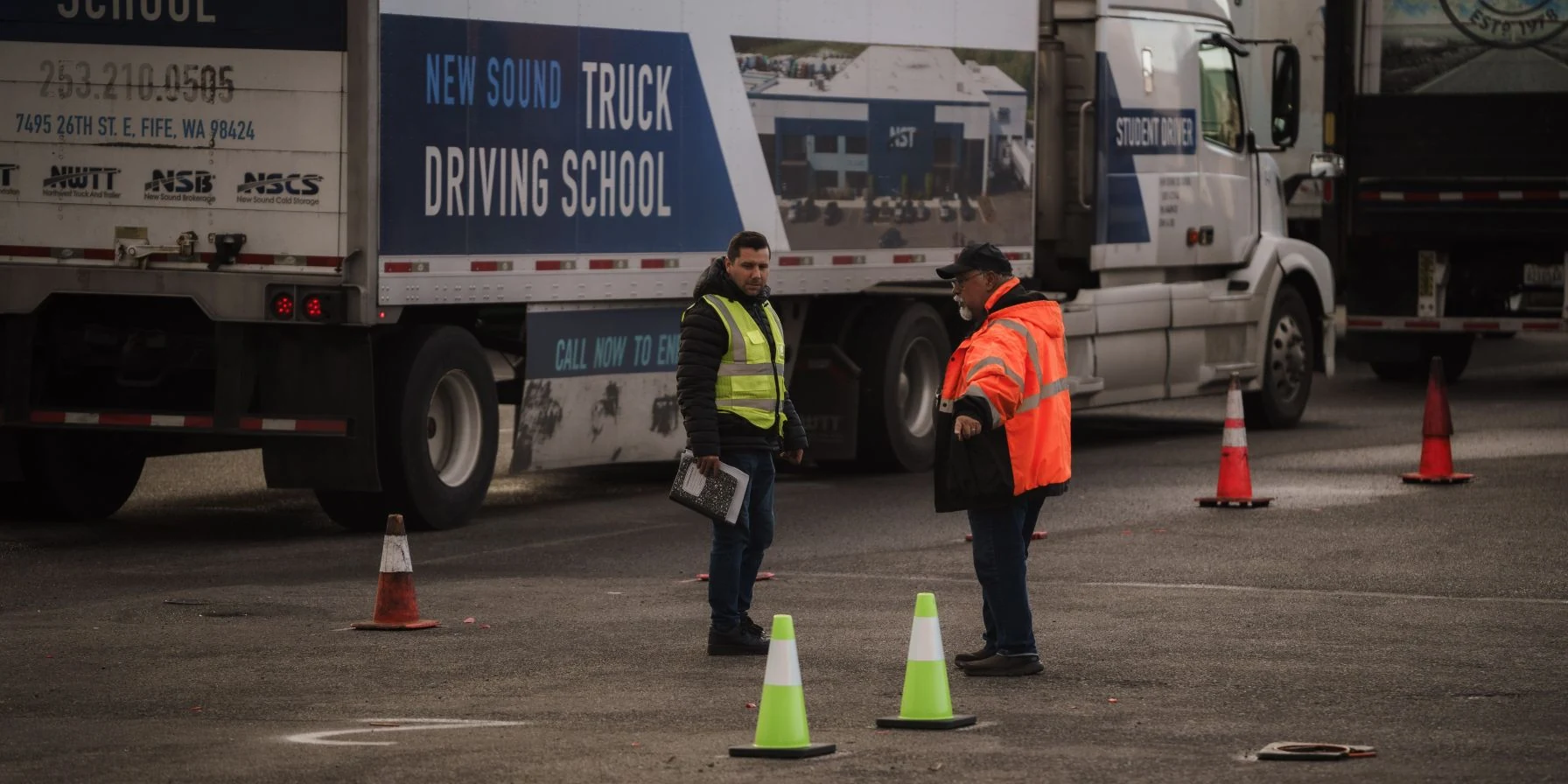
Our instructors at New Sound CDL School walk you through these steps on our paved training yard in Fife until the routine becomes second nature.
How Do You Inspect Air Brake Components During the Pre-Trip Exam?
Air brake components also need regular inspection. Washington's modernized CDL exam uses a specific inspection checklist, so not every maintenance check below is required on test day:
- Air Hoses and Lines: Check for leaks, cracks, or worn spots. Make sure connections fit tight.
- Brake Drums and Linings: Look for cracks, holes, or loose bolts. Check that linings have no oil or grease on them.
- Pushrods and Slack Adjusters: Check for broken, loose, or missing parts. Pushrod travel limits depend on the brake chamber size and type.
- Air Tanks: Ensure tanks mount securely and check that drain valves work properly.
Clearing all restrictions gives you the best path to high-paying driving jobs. You can learn more about the air brake inspection in our guide on how to test the tractor protection valve on the Washington CDL exam.
We understand sitting for the test can be scary, even our instructors get scared sometimes. They’re just really good at hiding it. You can read more about expert tips and tricks to pass your CDL exam the first time or read about how our students succeed in taking the exam.
Start Your Unrestricted CDL Training in Washington State
Testing for a CDL without any restrictions opens up the best driving jobs in Washington. And there’s many reasons why New Sound is Washington’s #1 choice to train.
We offer flexible full-time, part-time, and evening classes in Fife, Washington. Many students qualify for financial assistance, funding, or payment plans; just ask!
Call us today at (253) 777-3800, visit our campus in Fife, or contact us online to get your questions answered and start your CDL training!
Frequently Asked Questions About Air Brake Restrictions
Can I remove an L restriction from my CDL later?
Yes. You must schedule an air brake test with your licensing authority, pass the written air brake knowledge exam, and complete the required skills testing in an air-brake-equipped commercial vehicle.
What happens if the low-air warning light does not turn on?
If the warning light or buzzer fails to activate before air pressure drops below 55 PSI, or the manufacturer's specified level, the vehicle fails the air brake safety check. The examiner will determine whether the problem is an equipment failure or an incorrectly performed test.
What is the maximum air loss rate for a straight truck?
For a single Class B vehicle, the maximum allowable air loss during the applied pressure test is 3 PSI in 1 minute.
What is an air-over-hydraulic brake system?
An air-over-hydraulic system uses compressed air to activate a hydraulic braking unit. Because it does not use pure air pressure at the wheel ends, taking your CDL test in this vehicle results in a "Z" restriction.