


Does a Paved CDL Training Yard Matter? Concrete vs. Gravel
November 17, 2026
If you're comparing CDL schools in Washington, take a good look at their training yards before you sign up. We’re not saying that the training yard should be a deal-breaker, but it can be a good benchmark for the rest of the quality of that program. A clean gated and paved lot means that the school has invested into the best training environment for their students. A sloppy gravel lot with potholes and puddles can mean that the school is either new and inexperienced in training, or simply hasn’t cared to invest into the training grounds for their classes.
As a new CDL student, you already have plenty to think about. You're watching both mirrors, trying to keep a 53-foot trailer straight, and maybe learning to work a clutch for the first time, so the last thing you need is a pothole deciding where your tires go without your consent.
While gravel might seem like a strange or minor topic to cover, here’s our take on how various conditions can make an actual difference in your CDL training and road driving.
Does Rain Make a Difference When You're Learning to Back a Truck?
Anyone who's spent a winter around Fife or Tacoma knows how wet things can get. Rain doesn't stop because you've enrolled in truck driving school, and the training still has to happen.
On a gravel lot, water can settle into low spots and soften the ground. Once enough heavy trucks have passed through, those spots become ruts. You turn the wheel, ease into reverse, and end up fighting the ground along with the trailer.
We're not saying that every gravel yard is bad or impossible to maneuver. A lot of real-life scenarios will have you navigating gravel in the future anyway! So a well-kept gravel lot can serve its purpose, but a clean, level, paved surface gives students more consistent conditions to train on, especially through the rainy months. That's worth considering when you're spending thousands of dollars to learn a new career.
What's the Difference Between Backing on Concrete and Gravel?
A semi-truck is heavy, and its tires respond to whatever they sit on. Concrete and asphalt provide a firm surface, but gravel shifts around and mud does too.
Think about a student learning to back a manual truck. They're easing off the clutch and watching the trailer in the mirrors. If the wheels meet a patch of loose rocks, the truck may need a little more power to start moving. Then it moves farther than expected because it ends up catching some grip (not exactly helpful when you're trying to stay between two lines).
Why Does Tire Grip Matter?
One tire might sit on packed dirt while another rests on loose gravel. That can change the resistance the driver feels through the truck. On a nicely paved surface, the response tends to be more consistent, although rain and tire condition still matter.
We want students learning how their truck responds to the clutch and steering wheel. We don't want them guessing whether the next bump will change the movement and feel they've just worked so hard to master.
Can Uneven Ground Change What You See in Your Mirrors?
Absolutely. When you back a trailer, you use the mirrors to judge its angle, its rear corners, and the space between the tires and the cones.
Put a trailer tire in a rut, and the trailer may lean. Even a small change in height can change the view from the driver's seat, so a beginner might think they've turned too much when the ground has simply shifted the trailer's position.
What Should You Look for When Touring a CDL School?
Here's something we'd encourage every future CDL student to do: visit the school in person. Pictures of shiny trucks are nice, but you'll learn a lot more by seeing where the training actually takes place. We’ve had students enroll in nearby schools without visiting them first, then cancelling their enrollment after showing up for the first day of class because of the unexpected conditions of the facility!
Before you pay tuition, take a look at:
- The yard: Is it paved and kept in good shape, or full of holes and standing water?
- The practice space: Is there room to work with a full-length trailer without feeling crowded?
- The markings: Can you clearly see the cones and lines used for backing practice?
- The trucks: Are they clean, maintained, and ready for students to drive?
- The people: Are instructors patient? Is the office helpful when you have questions?
And ask how much time you'll spend driving instead of waiting for your turn. A nice lot means less if students can't get enough practice anyway!
Which Washington CDL Test Maneuvers Should You Practice?
Washington uses the AAMVA Modernized CDL Skills Test. During the basic control portion, you'll complete four exercises:
- Forward stop: Drive into a marked lane and stop the front of the truck in the box.
- Straight-line backing: Reverse between boundary lines without crossing them.
- Forward offset tracking: Move forward into the next lane without striking the cones.
- Reverse offset backing: Back into an offset alley and finish within the marked space.
The old 90-degree alley dock isn't a separate exercise on the current Washington test. The Washington DOL Supplemental CDL Guide explains the current maneuvers and scoring rules.
These movements take more than memorizing a steering trick. You need room to set up, enough time to practice, and an instructor who can show you what went wrong when a turn doesn't work out. We've covered the details in our Washington CDL backing test guide.
How Much Time Should You Spend Practicing Backing?
Washington requires at least 16 hours of backing instruction during a Class A CDL course. The full Class A program requires 160 hours of training, so four weeks full-time.
From what we've seen at New Sound CDL School, most beginners start to feel more comfortable after about 10 to 15 hours of active yard practice. Some students get the hang of things sooner, while others need more time with particular things, but that's what training is for!
This is honestly another reason to ask about the condition of the training lot. If you're spending hours learning to drive around, wouldn't you rather not spend that time walking and driving around muddy holes?
What Makes New Sound CDL School's Training Yard Different?
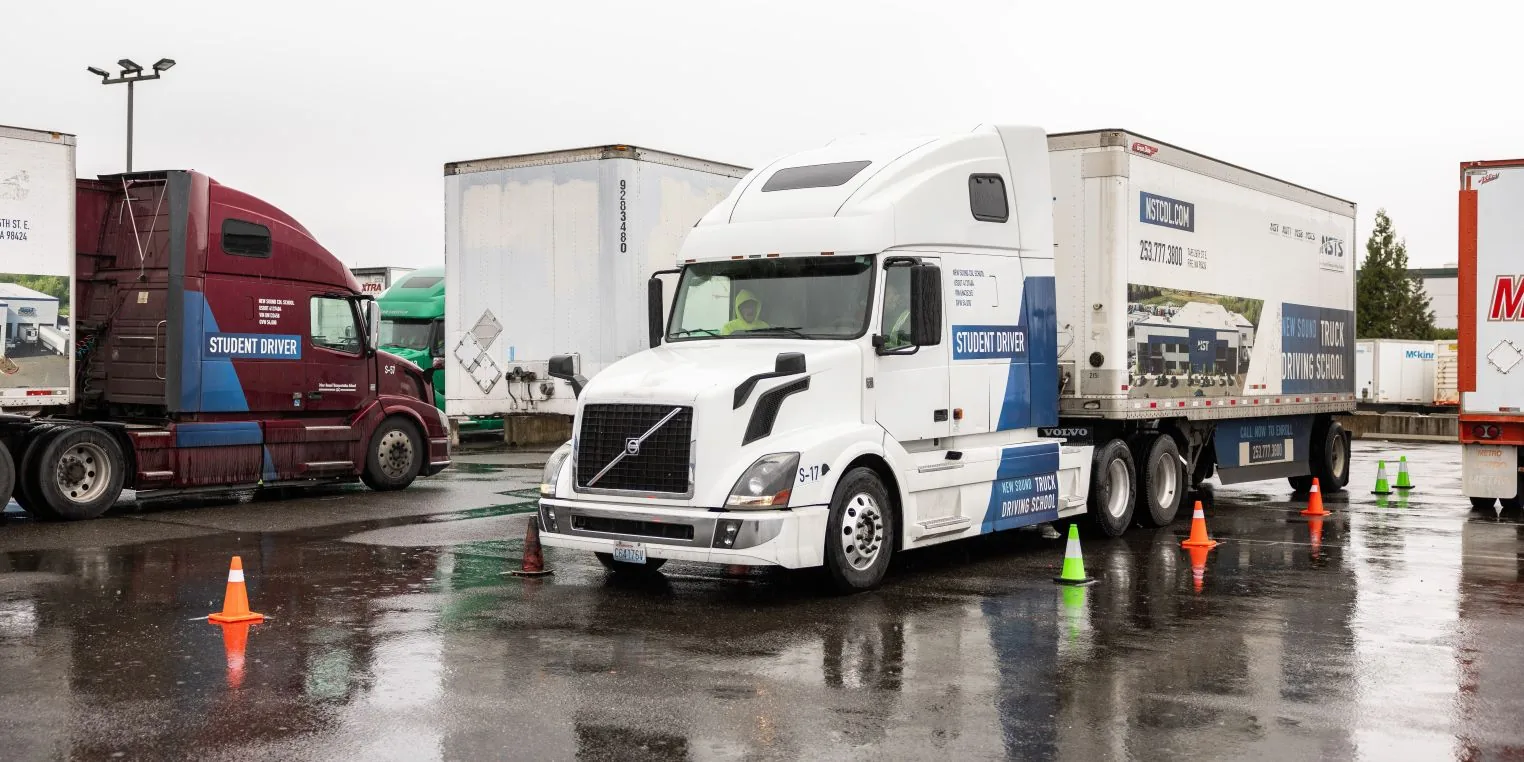
The paved parking lot at New Sound CDL School is modern, clean, well-lit, and even gated for your safety and security. This isn't normal for CDL Schools, if we're being honest. Many schools use gravel lots with deep puddles and muddy spots that make training more difficult and downright unpleasant (especially during the winter months where it's constantly cold, rainy, and wet). We don't share this to brag about ourselves, but to simply share how much care we've put into producing and maintaining a CDL school that you can look forward to training at day in and day out. Our trucks are clean, modern, and top-of-the-line. Our instructors are experienced experts who are genuinely kind and caring. Our administrative staff is present and helpful. With New Sound CDL School, you receive Washington state's best training because we've invested into the best environment, equipment, and people to ensure you have the best opportunity to succeed on your CDL exam and beyond.
Our graduate Thomas actually brought up the paved yard when he talked about his experience here. "I loved how the yard we trained in was all paved and not muddy and gravely," he said. He also praised the instructors who helped him build confidence. You can read more in his hands-on CDL training story.
Is a Paved Yard Worth Paying Attention to When Choosing CDL School?
We think so, but don't stop with the pavement. Look at the trucks, talk with the instructors, and see how the office treats you. Ask what your training day will look like and what kind of help you'll get if it doesn't come easily at first.
A student shouldn't have to guess whether a school cares about those details. You ought to be able to walk around, ask questions, and feel their care for yourself.
We're in Fife, a short trip for students coming from Tacoma and many surrounding communities. Our first-time CDL exam pass rate is over 80%. If you're comparing CDL schools, contact us and arrange a visit. Come see the yard and decide what you think.
Frequently Asked Questions About CDL Training Yards
Does Washington require CDL schools to have paved training yards?
Washington sets minimum training hours and other requirements, but those rules don't require every school to use a concrete yard. Pavement is simply a feature to consider when comparing schools.
Is gravel unsafe for CDL backing practice?
No, a maintained gravel lot can still be safely used for practice.
Can I visit New Sound CDL School before enrolling?
Yes. We encourage students to visit our Fife campus, meet the team, and see the trucks and training yard for themselves. We'd rather you know exactly what you're signing up for.